Construction Introduction

The construction sector is a major consumer of natural resources worldwide. Construction activities for buildings, streets and other public infrastructure have been steadily increasing in the last 30 years and now contribute significantly to global impacts:

  • Resource extraction for the construction and industrial sector has nearly tripled worldwide since 1980
  • 10-15% of building materials are wasted during the construction process
  • The use of our buildings account for 38% of all CO2 emission and 73% of electricity consumption
  • 530 million tons of construction and demolition (C&D) debris were generated in the United States in 2013—more than twice the amount of generated municipal solid waste
  • Demolition represents more than 90 percent of total C&D debris generation, while construction represents less than 10 percent

Despite the challenges, many solutions exist to cut emissions and better cycle our materials throughout our communities, economies, and industry sectors. This toolkit is dedicated to sharing advancements in materials management strategies for construction activities that conserve resources, cut emissions, and lead to long-term change for the built environment.

  1. Asphalt Introduction
  2. Concrete Introduction

Asphalt Introduction

This section of the Climate-Friendly Purchasing Toolkit is focused on two currently available and largely accepted measures for reducing GHG emissions from asphalt pavement production:
  1. Warm Mix Asphalt Concrete Pavement (WMAC)
  2. Reclaimed Asphalt Pavement (RAP)


Why Asphalt Concrete Pavement?

Asphalt concrete is commonly used in road construction by state and local governments.  It’s made up of roughly 95% aggregate, such as sand, gravel, and crushed rock, and 5% binder which is typically made of bitumen, a semi-solid form of petroleum. Hot mix asphalt concrete (HMAC) has been the standard for road surfacing and is widely used, understood, and well tested for performance and durability.

Sources of energy use and GHG emissions from asphalt production include:

  • Crude oil extraction, transport, and refining for the asphalt binder
  • Quarrying, hauling, crushing, and screening of aggregates
  • Handling, storing, drying, mixing, and preparation of materials for installation.
  • Transportation of the asphalt from the producer’s gate to the job site.

HMAC is an energy and GHG-intensive material and process because it requires heating the binder to between 300° and 350° Fahrenheit (F).  There is also considerable energy used to extract and refine the petroleum-based binder.  Therefore the immediate focus of GHG emissions reduction measures for asphalt concrete involves reducing the processing temperature and identifying lower-carbon binder substitutes.

GHG Comparisions

Figure 1 is a summary of greenhouse gas emissions and credits relative to baseline conditions (i.e. virgin materials) for various mixes using WMAC and RAP.  As can be seen on Figure 2, Net emissions are lowest for those scenarios with the greatest percentages of recycled content.  A pavement mixture using 30% RAP and warm-mix processing provides a 24% reduction compared to a mix using 100% virgin asphalt binder and hot-mix processing.


Figure 1:  Comparison of GHG emissions for RAP / WMA (WMAC) asphalt mixes.


Figure 2:  Difference in GHG intensity Virgin materials vs. RAP/WMA (WMAC) asphalt mixes.
 

Strategies

  1. Warm Mix Asphalt Concrete Pavement
  2. Use of Reclaimed Asphalt Pavement

Concrete Introduction

This section of the Climate Friendly Purchasing Toolkit provides specific strategies to reduce GHG emissions from the purchase of concrete. The most effective purchasing strategy for reducing the GHG impact of concrete is consuming less concrete.  This tool, however, will assume that the public institutional purchaser using this guidance has already reduced their demand for concrete to the greatest extent possible and is now ready to purchase concrete.

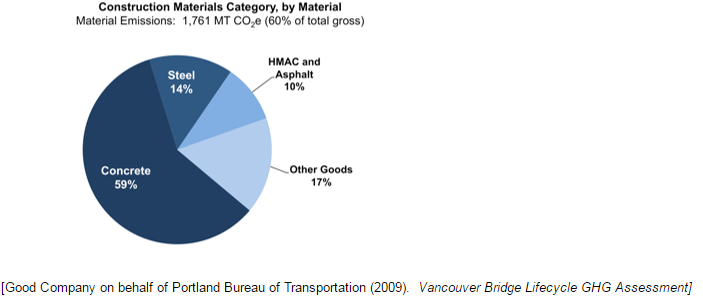
A study of 86 different public GHG inventories found that the purchase of concrete can comprise between 10 and 15 percent of all emissions (Good Company Meta Analysis, 2015)

The production of concrete is among the most greenhouse gas intensive building materials, comprising up to 5% of global CO2 emissions. State and local governments have found that purchasing concrete contributes significantly to their GHG inventories.   Since concrete is an essential material for both our transportation and building infrastructure, reducing the environmental impacts of concrete is of paramount importance.  Fortunately, there are numerous ways to reduce the GHG impact of concrete mixes.  Many of the methods which are discussed in this paper are not only well known by the concrete industry, but in some cases, are also cost competitive.

Greenhouse Gas Impacts of Concrete

Sources of Greenhouse Gas (GHG) emissions from concrete production include:

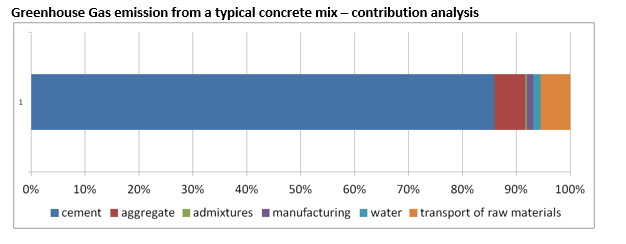
  • The processing of limestone into cement which requires significant energy inputs and creates a chemical reaction that emits carbon dioxide.
  • Quarrying, hauling, crushing, and screening of aggregates
  • Handling, storing, mixing, and method of preparation of materials

Given the high contribution cement has to the carbon footprint of concrete, the most effective means to reduce the GHG emissions from concrete is to simply reduce the cement content of the mix as much as possible.

Opportunities to reduce the GHG impacts of Concrete

There are several materials that can act as partial substitutes to Portland cement, which can lead to GHG and cost reductions. The material substitution measures discussed here include the supplementary cementitious materials (SCM).  Learn more here.

Government purchasers have numerous strategies at their disposal for lowering the greenhouse gas impacts of concrete purchases.  Overall, the concrete industry is actively developing and testing new supplementary cementitious materials to meet the demand for long lasting, low impact and safe concrete products.  The strategies outlined in this module will allow government purchasers to make meaningful reductions in their greenhouse gas impacts of their concrete purchases.

Purchasing Strategies to Reduce GHG impacts of Concrete

  1. Request or require Environmental Product Declarations (EPDs)
  2. Use of Supplementary Cementitious Materials
  3. Request or require recycled aggregate for concrete mixes