
Introduction
Managed Print Services (MPS) is a blanket term for all aspects of providing printing for an organization. In the past this meant a combination of individual desktop printers, large copiers for duplication, and maybe shared resources like color printers, and fax machines.
- Printers account for between 2-5% of energy use in the typical office building. While many have energy saving features, they still draw a significant plug load while on standby. Typically, offices use an output device only about 15 minutes (2%) of every business day. The goals of print management services and printer consolidation is to optimize the number of printers devices to adequately meet your printing needs, and consolidating printing service so each device is used more efficiently. In most organizations this involves transitioning from a model of owning (and maintaining) a large fleet of different equipment, to contracting for a service to provide the level of printing your organization needs. Doing so means you can have fewer machines, that operate more frequently, and you can set incentives for reducing total printing.
- While cutting carbon emissions is one outcome of a successful MPS program, most organizations realize significant cost savings, especially when considering the total cost of ownership (TCO, including equipment acquisition, maintenance, consumables, ICT support, etc.). Workplaces with significant distributed printing can save up to 20 – 50% on TCO by implanting MPS.
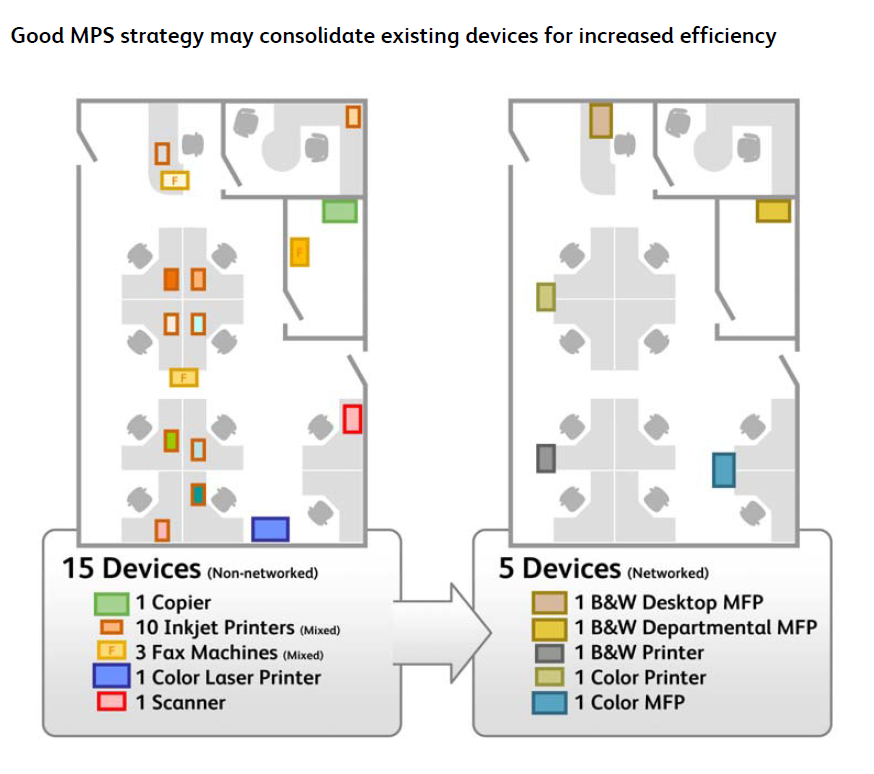
Source: Managed Print Services for Mid-sized Organizations, Xerox Corp., 2009
How it is done:
Shifting from many individual printers to a managed and consolidated printing environment has three main steps:
Step 1: Analyze printing needs for a building, office or facility. Organizations need to take a deep look at the printing needs of their employees, often called a “print assessment.” This involves understanding the current baseline, including:
- the number and types of different equipment that are in service, as well as a map of locations on each building floor
- the total number of “impressions” or pages that are copied on a monthly or annual basis, per machine if possible
- demands for specialized printing such as color, high resolution, large format plotting
- need for faxing or scanning
- needs for high volume duplicating
- needs for protecting private or sensitive information
- cost of maintaining existing equipment, including consumables such as toner, maintenance expenses, and estimates (if possible) of electricity use.
- Hidden costs of the current system, including demands on ICT departments, procurement, office management staff to service, and lost productivity from excessive down time.
This analysis can either be conducted by a stand-alone vendor, or as part of more comprehensive managed print services contract. In either case, the vendor should be asked to provide the following information:
– recommendations for consolidating or changing printer configurations to meet the identified needs, including leveraging existing print equipment (not all existing equipment needs to be replaced)
– estimates of cost implications, either savings or additional costs
– estimates of energy savings and GHG savings. For example, HP offers an online resource to estimate GHG and energy reductions from shifting equipment: HP Carbon Footprint Calculator
Step 2: Develop a Plan for Consolidation
Shifting from a mixed, desktop printing environment to a managed print environment can be a complex task. It involves significant workplace changes that need to be rolled out gently; a different procurement approach to secure a comprehensive service; and requires time for transition. Some of the key principles for a successful transition include:
– Leave adequate time for planning, engaging all the relevant stakeholders such as ICT, procurement, unions, frequent users, specialist staff, etc.
– Build in time and services for adequate training
– Make sure your contract language is complete and detailed enough to ensure you get the cost and efficiency savings you demand
Step 3: Implement slowly, and track results
The most successful examples of Managed Print Services are those where organizations seek a vendor to manage the entire printing enterprise. This changes the procurement approach from buying goods such as printers and copiers, to buying a service in which the vendor is responsible for installing and maintaining some or all of the printing equipment, and is paid based on the number of impressions or level of services that are provided. See the box “A different kind of procurement” for more information on contracting and procurement for MPS.
Some important features to consider in implementation include:
- Establish systems to allow for privacy, such as requiring a password to release a print job. This is important for any users who need to print Personal Identifiable Information or other confidential or sensitive information.
- Consider other features that help reduce GHG and other resources, such as requiring all employees enter a code to release a print job (cutting down on forgotten or duplicate printing); setting all equipment and software to default to double sided printing; and default to black and white printing to save on the often significant cost of color printing.
- Build service and maintenance into the contract to limit downtime, as this causes more problems when devices are widely shared. This should include both regular preventative maintenance and service standards for rapid response to breakdowns.
- Build in time and resources to train staff on new equipment and new procedures.
- Develop procedures and requirements for both your vendor and your organization to track progress and implementation, and to make shifts if needed. Some factors that should be tracked on a regular basis include total imprints, imprints per machine, user satisfaction, downtime, etc. You also need to make sure your contract allows for making changes to the configuration based on this information, as you may find some office or units need more or less service.
- Tracking and estimating savings in paper usage, electricity, and the GHGs associated with those efficiencies. The Paper Reduction section has links to those.
The contract must establish a current cost and equipment baseline based on the assessment suggested in Step 1; define clear end-state savings targets; and establish milestones that chart progress between the two. The simplest and most visible way to measure savings is by using a consumption-based “utility” approach, i.e., cost-per-page, exactly as for a contract for electricity, gas, telephone or water. This allows savings measurement at the unit cost level, paying only for what is used, and makes costs absolutely transparent and predictable. Vendor selection should highlight key business drivers beyond cost and standard service-level agreement (SLA) goals. Also, make sure any contract includes the ability (internally and by your vendor) to continuously monitor the printing environment. The “Purchasing Resources” section includes several great guides for setting up the bid and contract language for managed print services
The MPS market is quite mature. Some vendors offer separate print assessment services, or MPS services. Some MFD and equipment vendors will also provide print assessment and PMS. Purchasers will be on solid ground to request documentation of baseline print impacts and changes post-PMS efforts.
• Reducing Paper and Ink Usage: https://www.epa.gov/sites/production/files/documents/paper_usage.pdf
• Promoting Double Sided Printing: https://www.epa.gov/sites/production/files/2013-09/documents/fec_automatic_duplexing
Buying recycled content paper can also reduce supply chain GHG emissions. For more information, see How to buy 100% Recycled Content Paper